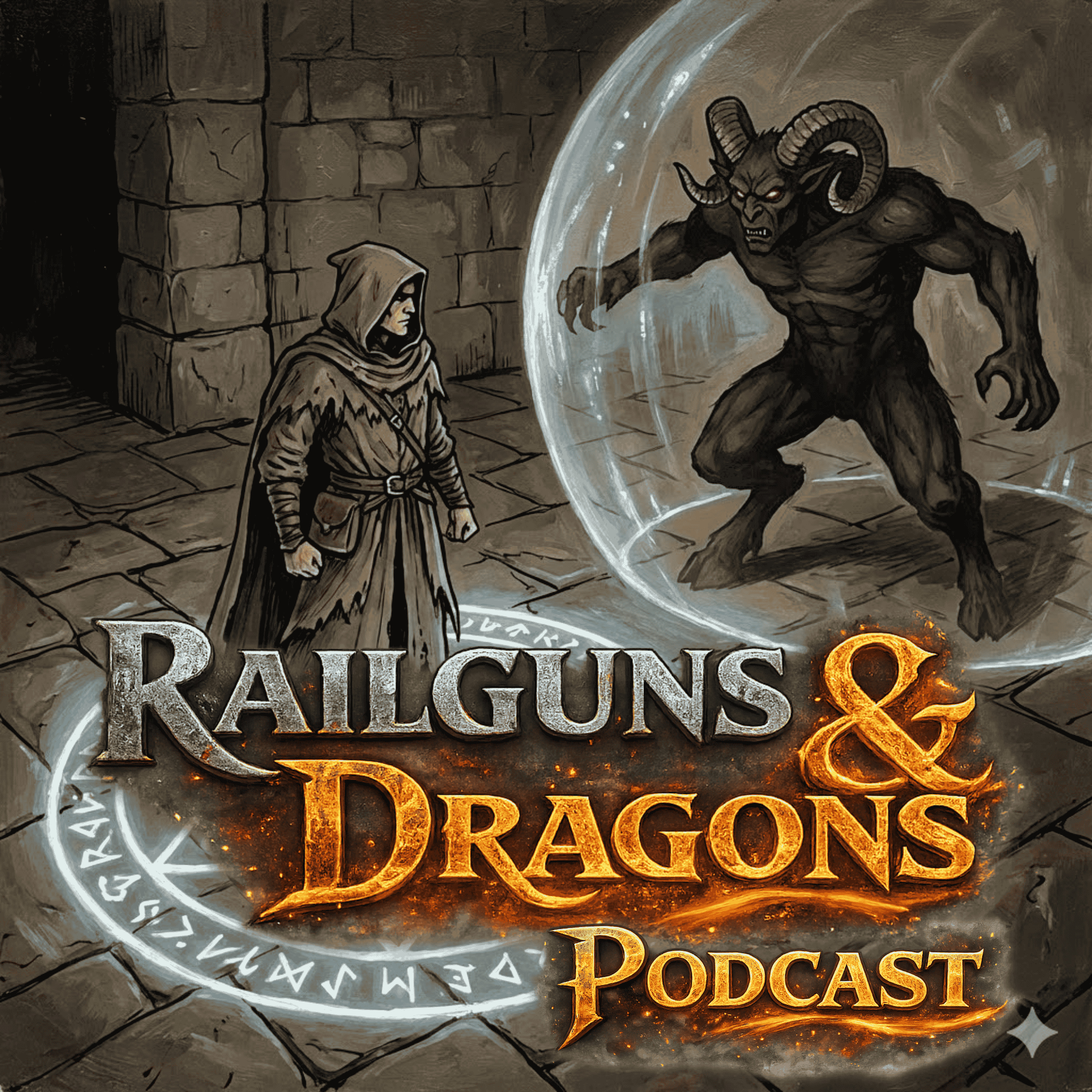
Episode 4 - The Circle & The Ward
The Story
Step away from the standard spellbook and enter the Palladium World, where magic is a science, a negotiation, and a trap waiting to be sprung. Join a Vince as he dusts off the Second Edition rules and talks "Lost Arts"... the forbidden magic that survived the purge of the Elf-Dwarf War.
In this episode, I talk about the Diabolist and the Summoner...two classes that trade instant gratification for ultimate strategic power. We discuss the lethal geometry of Ward phrases , the high-stakes gamble of the Battle of Wills , and why knowing a True Name is deadlier than any sword. If you are ready to master the runes and command the darkness, welcome to the table. The Old Ones may be sleeping, but we are just getting started.
Website: https://RailgunsandDragons.com
Hey folks, welcome back to Rail Guns and Dragons. I'm your host Vince and I know this podcast has been on a little bit of a hiatus since 2025. In the middle of the year, as I explained on our blog Rail gunsanddragons.com is that my Co host Rob decided that he did no longer want to do podcasting. So he kind of left me in a space with no one to podcast with. Now I decided here and there what I really should do with this podcast and a couple people in the Facebook groups had to said, well why don't you just do it solo like you do your other podcasts?
And I said, yeah, I could do that for quite some time until I find a suitable replacement Co host for this as I love Palladium books. I'm an ambassador of Palladium books. I mean, probably so is everybody else, but I enjoy them. I have a huge library of Palladium books and I really want to talk about Palladium. I noticed there was a lack of just a focus Palladium podcast. As far as fantasy. There's a couple out there that do whatever they do. The Death Head Taco truck, I believe that's the name of it.
They do an awesome job. Those two dudes just kind of sitting there and I think they're in a truck and just talk about Palladium and I really enjoy that one that they're really cool. That's probably the only one I listen to or I could, you know, want to listen to. But today I just want to say welcome back. And if you want to listen in today, we're going to talk a little bit about something that might be interesting. I don't know. We're going to go a little deep into the, you know, the book we're running games for Palladium World since, I don't know, the 90s, early 80s, I mean late 80s.
I've seen 1000 woven quests. I've seen changeling spies infiltrate the Western Empire. I've seen enough fireballs to burn down the jungles twice over. It's been a lot of fun over the years, but there's something special about Plating Fantasy Second Edition that I feel doesn't get enough love. Everybody wants to play a wizard because, you know, instant gratification, right? You say the magic words boom, lightning bolt. Or you play a warlock because you want to be best friends with the cool fire elemental and you know, whatever you want to be that cool fire elemental pet guy.
Well, today I want to talk to you about a sinking man's magic user OCC the the class that requires prep time, strategy, and a little bit of madness. I'm talking about the lost arts that survived the Elvin Dwarven war. I'm talking about Diabloist and the Summoner. I've done a couple videos on these things on my YouTube channel at youtube.com slash at the evil DM, the evil DM. Now, if you've ever played Dungeons and Dragons, which probably a lot of us have, and moved over here because they'll like Palladium a little bit better, and you haven't played these classes, so you're right dumb and never really played them, it's going to blow your mind because they don't work like anything you used to.
So let's crack open this book called Palladium Fantasy Second Edition and look why these two classes, in my opinion, are probably a good flavor of how Palladium works. So let's start with the Diabolos. In the book they call him the Silent Mage, and that's probably one of the cooler nicknames I've heard Kevin put on a class, or any game designer for that matter, the Silent Mage. I like that a Diabolos doesn't really cast spells. They don't chant, they don't dance around, they write. They are the master of wards and ruins or ruins.
Excuse me now war wise this is huge in the Palladium timeline. During the age of elves, magic was everywhere. But after the elf dwarf war, the two sides realized that you had nearly destroyed the world with rune magic. So they perched it. They haunted down the rune masters and they killed them. The secrets of making rune weapons, those indestructible soul drinking swords that we all want to slit the throats of the bad guys with and become the hero or maybe even be the bad guy with the sword to kill the hero are long gone.
But the the obelisk actually remembers the alphabet. They can make this. They can't really make the swords anymore, but they can use the symbols to create magic traps and protections. Let's look how let's look how this works mechanically because a lot of people can't wrap their head around these classes. And this is where the the obelisk sometimes in, in my book, has become the ultimate MacGyver in quotes of the party. If you remember MacGyver from the 80s TV show, I'm not talking about the new one.
I've never watched that. The obelisk places a word symbol on an object or a person. To make it work, they need to combine symbols into like a certain phrase. Let's say you're camping in an old Kingdom in the mountains and you're worried about COBOL sneaking in. Well, a wizard would have to stay awake and, you know, possibly cast a spell or whatever. A temporary spell, whatever key would maintain it, whatever. The obelisk takes a piece of chalk, maybe some paints with some resin, and draws a symbol on a rock.
Boom. He draws a symbol for alarm. He combines with the symbol for area of effect. Now if anything enters that area, the sound alarm goes off and the Diablo's head. He wakes up, wakes the party, and you ambush the Cobalts instead of them ambushing you. But let's get a little nasty here because some people are saying yeah, big deal. Let's say you're being chased by a ball rock. You run through a door. You don't dislock it, you paint a ward phrase on it. You paint a trigger and by condition evil, inflict and agony.
Now when the demon touches the door, he doesn't just get locked out, he gets hit with the magic that causes stabbing pain in his head and stomach. He loses initiative, he loses attack and his speed is cut in half. And you know what the best part about all this is? The Diablos is immune to his is immune to his own wards. You can trap your own spellbooks so that if a rogue in your party tries to steal it, they go blind for 10 minutes. Not that I recommend, you know, in party fighting, but hey, thieves, these thieves.
And I've had a lot of player characters and groups do this to one another. So here is a catch That, and This is why playing a Diabolist is kind of challenging and it takes a little bit of time during a war really is an instant. If you sketch it, it takes a melee a round or two. If you carve it into what, a stone? It could take hours depending on how well you do it. But if you carve it, it does last until the object is destroyed. That is the benefit of it. I don't know. Once you spent his downtime carving protection from undead onto the armor of everyone in the party, it took him weeks of game time.
But when they finally raided that vampire later, vampires really couldn't touch them. They were walking tanks of holy repulsion at that point. The power is that, and that is the power of the Diabolis. They aren't artillery, they aren't your engineer. You prepare the battlefield before the fight even starts. They also get a permanence ward and this is like a Holy Grail when it comes to certain things that they can do. It costs a massive amount of PPE, potential psychic energy to those that are listening for the first time to activate.
Usually requires A sacrifice or some type of Nexus point, but it does make the effect of magic permanent. And Speaking of PPE, that does bring me to the other lost art here. The class that makes everyone else at the table nervous. And I had a player who played this class, the Summoner, and he didn't quite understand the class itself, also known as the Circle Master or the Mad Mage. My player who played this class thought we were playing first edition of the time because we had just transferred over from Advanced Dungeons and Dragons and we were playing pleading fantasy or just Palladium as they called it back then.
And he thought by playing a Summoner based on some of the rules that he would be able to command or control anything that he wanted to without a problem. Well, little did he know that. Yeah, while the original 1st edition book does leave a little bit out of the rules, they did have to do something in High Seas Book 3 to kind of do a little Q&A and update the class as far as what it could and couldn't do and how long it took. Things. He thought he would just create this control that person, and he would have like this ultimate munchkin power over everyone, which, Oh well, didn't work that way.
People get saves. They can't just automatically be under your control. But you know, Second edition cleaned a lot of this up. So if a diabolist is an engineer the summer, the Summoner is a nuclear physicist who doesn't quite know if the reactor is stable.
In most RPG, summoning is just a spell like summon monster 1, Summon Monster 2, right? You know, you've heard those spells before. You cast it, a badger appears, it fights for you, and then, you know, skitters away. In Palladium Fantasy Second Edition, summoning is a ritual. It is dangerous. It's dark and incredibly favorable. And here's how it works. A Summoner just doesn't wave a wand. They have to draw a magic circle on the floor. They need components, usually candles, gems, specific colors, and, of course, blood.
Yeah, I said blood. To activate the summoning circle, you almost need blood, A blood sacrifice of some sort. Now, before you get squeamish and the book says, the book says it could be an animal, a chicken, a goat, or a pigeon. But it sets the tone, doesn't it really? I mean, you're ripping the hole in reality and putting, pulling something through to do your bidding or whatever. Here is the mechanics that make this so intense. The battle of wills. When you summer summer, when you summon A lesser demon, it appears in the circle.
It's trapped there, but it doesn't have to obey you. You and the demon have to roll off. The demon has to roll a saving throw against your mental endurance ME attribute. If the demon wins, it just sits there and laughs at you. It insults your fashion sense and your mom, and it refuses to help. Now, if you win, which is your whole goal of summoning these things, it's subservient. It has to has to obey your commands. But here is the kicker in this whole situation, if you fail to control it, you now have a demon living in your room who is very annoyed.
You could try to banish it back to Hades, but there's a chance it resists that too. If it stays, it might try to trick you into breaking the circle, and if that circle breaks, well, you're now the demon's bitch, so it'll be harsh, but that's how it is. I love this mechanic because it makes magic feel really dangerous in the Palladium world. It's not just a vending machine. It's basically a negotiation with the shark. If you kind of get me an idea here. The Summoner has access to different types of circles.
You have protection circles, which are great for camping in dangerous territory. You draw a protection from undead circle and vampires, literally, or whatever undead can just, you know, really can't cross that line. Then you have your summoning circles, which we just talked about, and you can summon almost anything, angels, demons, elementals, insects, animals, whatever. And then finally the power circles. These are the big guns. Let's talk about the Power Matrix. This is unique to Palladium. It allows you to link circles together.
You can have a summoning circle linked to a power circle that gives you the strength to control what you just summoned. It allows for a complex magical setups that you just don't see in other systems. One of the coolest role-playing elements of the Summoner is the concept of true names. In Palladium, when you have the true name, you have power. If a Summoner knows the character's true name in quotes, the name of your parent that you were given, a name of your parents gave you at birth, he receives a massive bonus to summoning and controlling you.
This leads to the great cultural quirk where characters in Palladium world often go by nicknames or some type of public name, keeping their true names secret to avoid magic slavery. I even had my characters when we were playing the game have their true name written on their character sheet and then what people call them in public. So if you play a Summoner, your quest isn't always for gold, it's mostly for knowledge. You want to find the true names of the local bands so you can summon them into a circle and forcing the call off as tax collectors.
You really want to do that, but I've had characters try to do stupid things like that. But why not? You want to find lost books that contain the diagrams for the dimensional rift circle so you can travel to other worlds and experience other things. Now a quick comparison for few veterans out there. Why play these two instead of a wizard? A wizard is versatile. They learn spells. They cast them fast, usually in two per melee around. They are your combat artillery, but Diabolos and Summoners are your force multipliers.
A Dabol Diabolos makes the whole party's year better. He puts wards on the fighter's shield, so blinds the enemies. He wards the thief's bag so nobody could steal from him. He creates the safe house where you rest the Summoner. He brings the reinforcements. Why fight the ogre Chieftain yourself when you can summon A Gargoyd Lord to do it for you or summon a shadow beast to spy on the enemy camp? Well, correction, he can try to do that if he really wants to. He's high enough level, level that is, and definitely a game changer when it comes to that stuff.
But you have to deal with the stigmata when it comes to all these things. The lore of the book is very clear. During the Millennium of Purification, elves and dwarfs haunted these guys down. Rude magic and circle magic were often seen as dark arts. If you walk into a town in eastern territory and narrow and announce your summer, people might think you're a witch. They might think you can sort with the Old Ones. And honestly, you probably do consort with demons, and that's kind of part of the fun of the whole class.
So here's my challenge to you out there. If you're starting a Palladium fantasy campaign, look at the Men of Magic section again. Skip past the wizard, skip past the warlock. Look at the Diabolist, and look at the Summoner. Think about playing characters who treat magic like science, or a contradiction, or a contract law negotiation. I should say. Play the Diabolist who is obsessed with finding lost, ruined magic, carrying around a notebook full of symbols and combinations. Play the Summoner who is constantly trying to outsmart the demons he calls up, walking that razor's edge between old with power and being eaten alive by these demons he's summoning.
So these classes are for a role-playing depth that is baked right into their mechanics. They struggle for components, time management, they hunt knowledge it it drives the story forward with role play and a lot of fun. And one last tip for Game Masters out there running these classes for their group, give them time. If you run a hack slash game where players never stop moving, these classes will feel useless and probably wouldn't fit very well because they need prep time, need a few hours to do what they need to do.
So let them have some time. Let them have a stronghold, let them set traps. If you let them use your abilities, they will surprise you every single time. There's nothing funnier than watching an invincible NPC villain trigger a power ward, link to paralysis condition, and drop like a sack of potatoes in front of you. All right, I think that's going to be enough for this episode. For this week, I hope you're inspired you to dust off the book and roll up something weird. Roll up something interesting in the comments below on either on Spotify or you can go to railgunsanddragons.com.
Tell me about your experiences playing in Diabolis. Did you ever mispronounce a power word and blow up your own party? I want to hear the war stories. If you enjoyed this, you know, kind of a deep dive into the Pallium world, don't forget to like the podcast on Spotify. Subscribe, rate US five stars. And you know what else? If it helps, it helps the channel when you do these things, either when it comes to Spotify or Apple Podcasts, wherever you're listening to it. And you know, every, every like and comment keeps the old ones asleep for another day.
No, I'm just kidding. Until next time, keep your powder dry and your circles sealed. Don't forget to head over to railgunsanddragons.com and follow the blog there. That helps out too. All right. Good night, everybody.
 Apple Podcasts
 Castbox
 Castro
 Goodpods
 Moon FM
 Overcast
 Pocket Casts
 Podbean
 Podcast Addict
 Podcast Republic
 Spotify