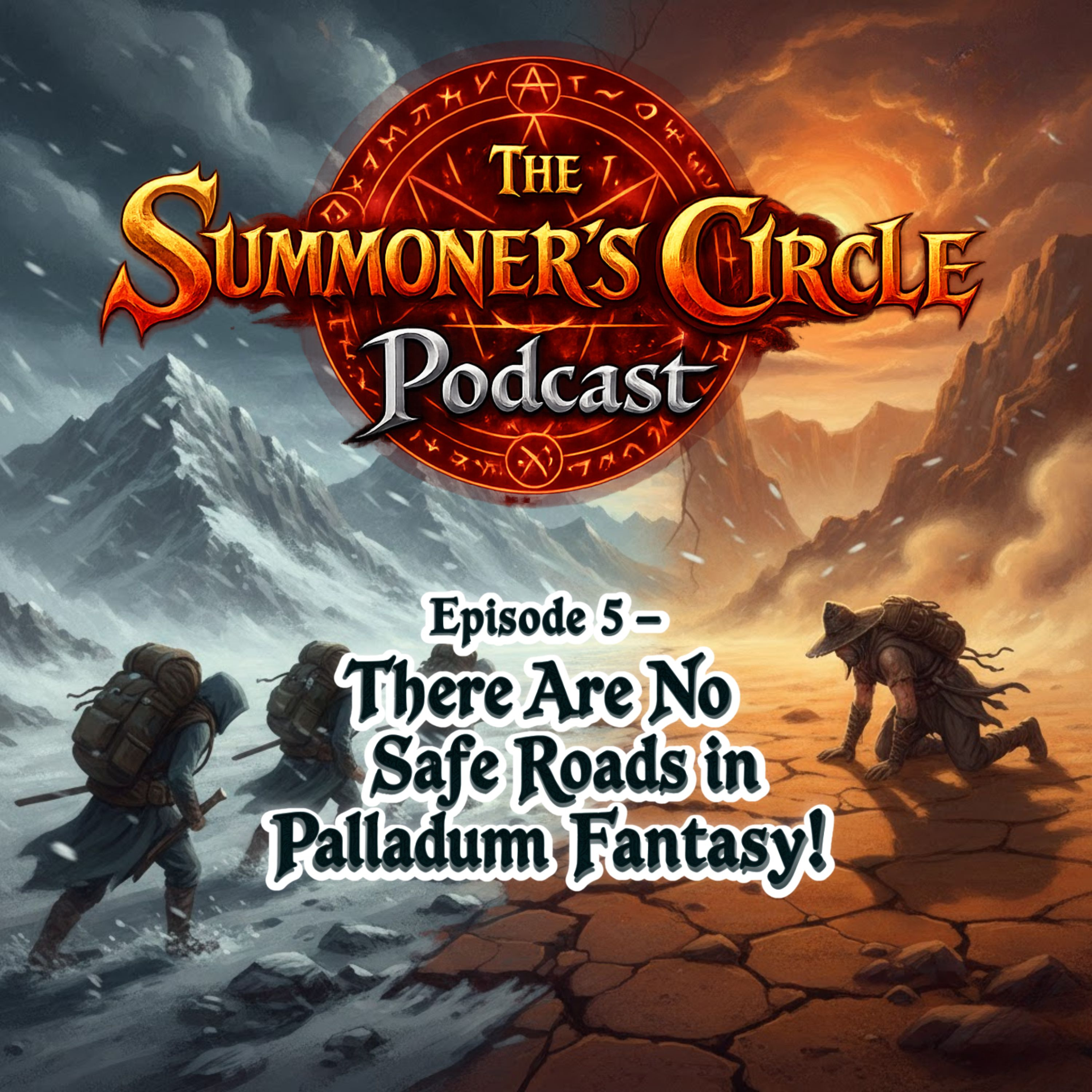
Episode 5 – There are No Safe Roads in Palladium Fantasy!
The Story
Today, we are talking about why moving your characters from point A to point B in Palladium Fantasy should never be boring. I used to treat travel as filler, but the books tell a different story. If you look at sourcebooks like Northern Hinterlands or Baalgor Wastelands, you see that the world itself is a threat. We are talking about mechanics for exhaustion, freezing cold, and blistering heat that make every journey a struggle for survival. Stop ignoring the weather and start making your players respect the road.
Got a wild story or a cursed character build? Send it our way at Railgunsanddragons.com or email [email protected]. Your madness could shape a future episode.
Next Episode drops on 1/28!
#ttrpg #palladiumfantasy #roleplaying
Hey folks, welcome back to the table. This is the Summoner Circle podcast. I am your host, Vince. This is season 2. We're starting season 2, but it's going to be episode 5. And today I want to talk about something Palladium does that I think a lot of people either forget or quietly ignore. It's travel, not combat, not magic, not classes, just moving from one place to another. Because if you actually read the Palladium Fantasy books, especially the source books, you start to realize something pretty fast.
The world itself is hostile. And I don't mean in a vague fantasy way, I mean mechanically hostile. In Palladium Fantasy, the wilderness is not just a backdrop between encounters, it's an active threat to be honest. And once you start running it that way, the entire game changes. So let me explain where this clicked for me years ago. Like a lot of G Ms. I treated travel as kind of like a filler. And a lot of G Ms. often do this. You know, you're in a town, you leave the town, you get a random encounter or two, you arrive at whatever location, dungeon, town, whatever.
Done. But Palladium doesn't actually support that style very well. If you read what's on the page. Once you crack open the book, like Northern Hinterlands or the Baguadar waste, Balagor Waste, Excuse me? You realize how much ink Palladium spends on on things like weather and terrain and fatigue and dehydration exposure and even bad decisions at this point? There are entire sections in the book about cold, entire sections about heat, entire sections about bad footing. And that's not really accidental.
Palladium is telling you something very cleverly. Getting there is kind of part of the adventure and the experience. So let me start with something simple here. Distance and Palladium, distance matters. You're not traveling fast across the map or fast traveling, as we say in Mmos. You're actually counting miles. You're dealing with terrain penalties. You're dealing with encumbrance, what you're carrying. That alone forces players to, you know, slow down and wait a tick. I've watched other players plan roots in Palladium the way they never would in other systems.
They ask questions about the land, like, are we following the river, or are we cutting across that river? Is the wagon worth bringing? How much food can we realistic, realistically carry without having to worry? Those questions don't come from paranoia. They come from experience books. Palladium punishes bad decisions and logistics. Talking about the weather now because this is where Palladium really gets nasty in a quiet way. Take the Northern Hinderlands. Cold is not flavor tax. Cold kills you.
Hypothermia is not not a narrative condition. It has rules. It has stages, it has it stacks with fatigue on your character. You fall into cold water and you just don't shake it off. You're now on the clock of slowly kicking away. And here's the important part. None of that involves monsters. I've run sessions where the most dangerous thing the party faced was a snowstorm. No initiative, no attack rolls, just bad decisions compounding over time. And that puts tension into the game, makes it more interesting.
And the same thing happens on the other end of the spectrum. Bagodor Wastelands is a brutal in the opposite direction. Heat exhaustion, weather consumption, armor penalties, Heavy armor is not your friend. To be honest, they're trying to explain that to a knight who refuses to take it off in the desert. These things are going to happen to you. You're going to start to sweat. You're going to start to dehydrate. Palladium doesn't care if you're heroic. Heat stroke still applies to your average character.
Now here's where the this really starts to matter. When traveling is dangerous, camps matter. Where you sleep matters, how you sleep matter, and who's on watch matters. Protection circles, wards, scouts, alarms. Not because the GM might ambush us, is what the players are saying, but because the world is unsafe by default, and that what was what creates natural roles at the table. The Ranger suddenly matters. The wilderness savvy character matters, the guy who knows how to build a shelter matters, and Pallium supports all these things.
Skills like wilderness survival, land navigation, and even horsemanship stop becoming fluff and become something that keeps you alive. Now let me kind of pivot into the Land of the Dam for a second. And we did do a YouTube video on that one. If you go to theevildm.com on YouTube, he did Land of the Dam because this is where Palladium turns everything up to like 20 in these books. Watch that, those books. The land itself hates you. Curses, corruptions, elemental effects that follow you. You just don't enter the region, you pay for it.
Even resting is dangerous. And what I love about that design is this, you don't need to constant combat to make the play feel lethal. The land just works for you as AGM. Now that we're talking about AGM, I want to talk a little bit to the GM for a moment here. If you're running Palladium Fantasy and your players feel invincible, you're probably skipping things like this. What? I'm talking about travel. You're probably compressing it. You're probably saying things like yeah, yeah, you get there in a few days.
Oh it takes you an hour. And you know what? That's fine sometimes. But if you never let the world push back, you're missing 1 of playings biggest strengths. I'm thinking travel is where the tension builds up. It's where resources drained, it's where plans get tested, it's where characters reveal who they actually are. The fighter who can't handle the cold. The mage who forgot the food? Whoops. The leader who chose the wrong route. These moments stick. I still remember campaigns where nobody remembers the dungeon boss, but everyone remembers the storm that almost killed them on the way there.
That's basically Palladium in a nutshell. Now let me say something important here. It's not really being about cruel, It's about being consistent. If players prepare, reward them. If they plan routes, let it matter. If they invest in pack animals, let it pay off. And if they ignore the world, let the world respond back to them for ignoring it. That's not punishment, that's immersion. Plays and fantasy assumes the world existed before the players and will exist after they're long gone. They're just trying to survive in it, and once you run travel that way, everything else clicks.
Combat feels riskier, rest feels earned. Towns feel safe for a good reason. To be honest, you need to stop needing constant monsters to make the mood. The world does work, and that's why I wanted to start season 2 here. Not with classes, not with magic, but with the ground your characters are walking on. Because Palladium Fantasy 2 E is at its best when the world is the challenge. Now, let me tell you something else that Palladium does really well. Once you start leaning into travel, it teaches players restraint.
That sounds weird, but hear me out here. And a lot of games, players Sprint everywhere. They chase every hook. They assume they can just push a little further. Palladium punishes that mindset, not going to lie. Fatigue builds up, supplies run low, horses get injured, armor starts to feel like a liability instead of a protect protection, especially in heat. I've had parties turn back not because they were afraid of the dungeon, but because they knew they couldn't make it back alive if they went any further.
That's a very different kind of decision making, and when players start making those calls on their own, you know the game is working. Now let's talk about mounts and animals for a minute, because Palladium actually cares about them. Horses are not motorcycles. Pack animals are not infinite backpacks. They eat, they get tired, they panic. I've had entire episodes hinge on whether a horse breaks a leg on a bad terrain or whether the mule Spooks during a storm and bolts away from them with their supplies and gold.
That's not cinematic. That's just grounded role-playing in the game, and players remember these things. It's really surprising they do. I still remember a campaign where the player lost their pack animals halfway through a journey, not some monsters to the terrain and exhaustion. They kept pushing the animals over and over and not thinking about. They need rest too. They lost gold. They lost food, tents, spare weapons, extra arrows. Suddenly the tone of the campaign shifted away from We got this, that oh crap, they weren't heroes on a quest anymore, they were people trying to just get home at this point without dying.
That kind of pressure doesn't come from random encounters, it comes from the world pushing back, and Palladium gives you the tools to do that without being arbitrary. Now let's talk a little bit about the maps, because that ties at the travel in a big way. Palladium maps are intentionally vague. They are not GPS devices. They're rough guides, and that's important. Players who assume maps are perfect will get into trouble fast. Rivers aren't always where you think they are. Trails fade. Landmarks do change.
I've had players argue over a map for about 10 minutes before realizing the map was worthless. That wasn't a trick, that was the setting. Civilizations rise and fall, borders shift, and roads, Roads just kind of disappear. Routes go away. Things change, maps change over time. Again, the world feels alive because it doesn't bend around the party, it bends. The world bends to itself and people have to adjust. Now I did mention camps, so let's talk about that for a second because this is where Travel Rd.
becomes personal in Palladium. Camps is not just, you know, hey, we rest it's decisions. Do you camp near the water or avoid it because of predators? Because predators need water. They're going to go there first looking for food and drink. Do you light a fire and risk attention or do you go cold and risk risk the weather element exposure? Do you post watches and if so, who actually stays awake? I've seen parties come to arguments and blows over who wants what watch schedule because they want their character to sleep more.
You know, that falls on the role play and that's stress revealing character for some people. Palladium encouraged it because sleep matters, fatigue matters, surprise matters. If you hand wave camp scenes, you're skipping some of the best tension the system has to offer. Now I want to touch briefly on sea travel because a lot of people just kind of wave their hands on that because Adventures to the High Sea does the same thing, just a lot better. The ocean is not just a hallway. Storms matter. Navigation matter.
Crew morale even matters. A ship is is a moving environment full of tons of problems, like food spoils, water running low, people getting sick. And yeah, you probably say water running low, but there's plenty of water. No, it's sea water. You can't drink that, dummy. Even if you boil it, I don't think you really can drink that. And all along, the monsters are pretty much obsole in this setting. The environment does the heavy lifting. This is why Palladium fantasy feels different from a lot of fantasy RPGs.
It's not just about what you fight. It's about what you can endure. Now, let me switch gears and talk directly to the GMs out there who might be listening and thinking. Yeah, but my players hate bookkeeping because, you know, that's coming up. You know, you're thinking that your players don't. Here's the thing about that. This isn't about tracking every pound of grain or whatever. It's about making choices matter. You don't have to run every rule every time. Remember, you roll the book. You rule the book, not the other way around is why I always say.
But if you never let travel matter, players will never think about that or respect that of the world. Pick your moments. Long journeys, harsh regions, desperate situation. That's when you lean in, and when you do, the book has a hell of a lot of support for you. You're not inventing difficulty here, you're using what's already there. Now let's give you one more example that really kind of stuck with me when I was going over this, trying to figure out what to talk about. I ran a campaign where the party had a choice.
Short route through a dangerous terrain, long route through a safer land. They chose the safer route. They survived the monsters, but the terrain really wore them down. By the time they reached their destination, they were exhausted, undersupplied, and half dead. The dungeon itself was almost anticlimactic. The journey was the story. That's when I realized Poyaima had been teaching me how to run it all along, and I just wasn't really paying attention. The books weren't just giving me monsters and spells, they were telling me how the world works.
And a lot of people just don't realize that coming from Dungeons and Dragons, you don't have that. Most of the books are just very generic. And once you let the world be dangerous, everything just kind of falls into place. Combat stops being routine, magic stops being casual, rest stops feeling guaranteed, and players start respecting their character limits. That's powerful, that's memorable. And that's why people still talk about Palladium campaigns for years to come. Not because of step locks, because of moments, storms, bad choices, hard nights, close calls.
That's what Palladium Fantasy is at its best. And that's why I wanted to start season 2 with this topic. Because before we talk about classes, monsters, weird rules, we need to talk about the ground that's supporting the feet of the characters. If you get travel right, everything else gets a lot easier in the book. Well, maybe, maybe not. All right, I'm going to stop here before I ramble too much more about all this, because next episode we'll we'll start grounded. Not sure what I really want to talk about.
Maybe I'll talk about camps and shelters and strongholds. I don't know if you got travel horror stories from your campaign. I want to hear them. Because if you played Palladium long enough, you've earned at least one story. So for the future, keep your rations dry, don't trust the weather, and don't assume the road is safe because the map says so. Check out the podcast at railgunsandragons.com where you'll see these posts with these shows and you can comment away with your I guess you could sign up with Google and comment away or you can comment away on the Facebook post or probably an X post or something.
We're available on all platforms. And yes I am looking for a Co host. Ask of the DM at the evil dm.com is my e-mail address. You can e-mail me there and we'll discuss. With that said, I'm going to head out. Good night everybody.
 Apple Podcasts
 Castbox
 Castro
 Goodpods
 Moon FM
 Overcast
 Pocket Casts
 Podbean
 Podcast Addict
 Podcast Republic
 Spotify