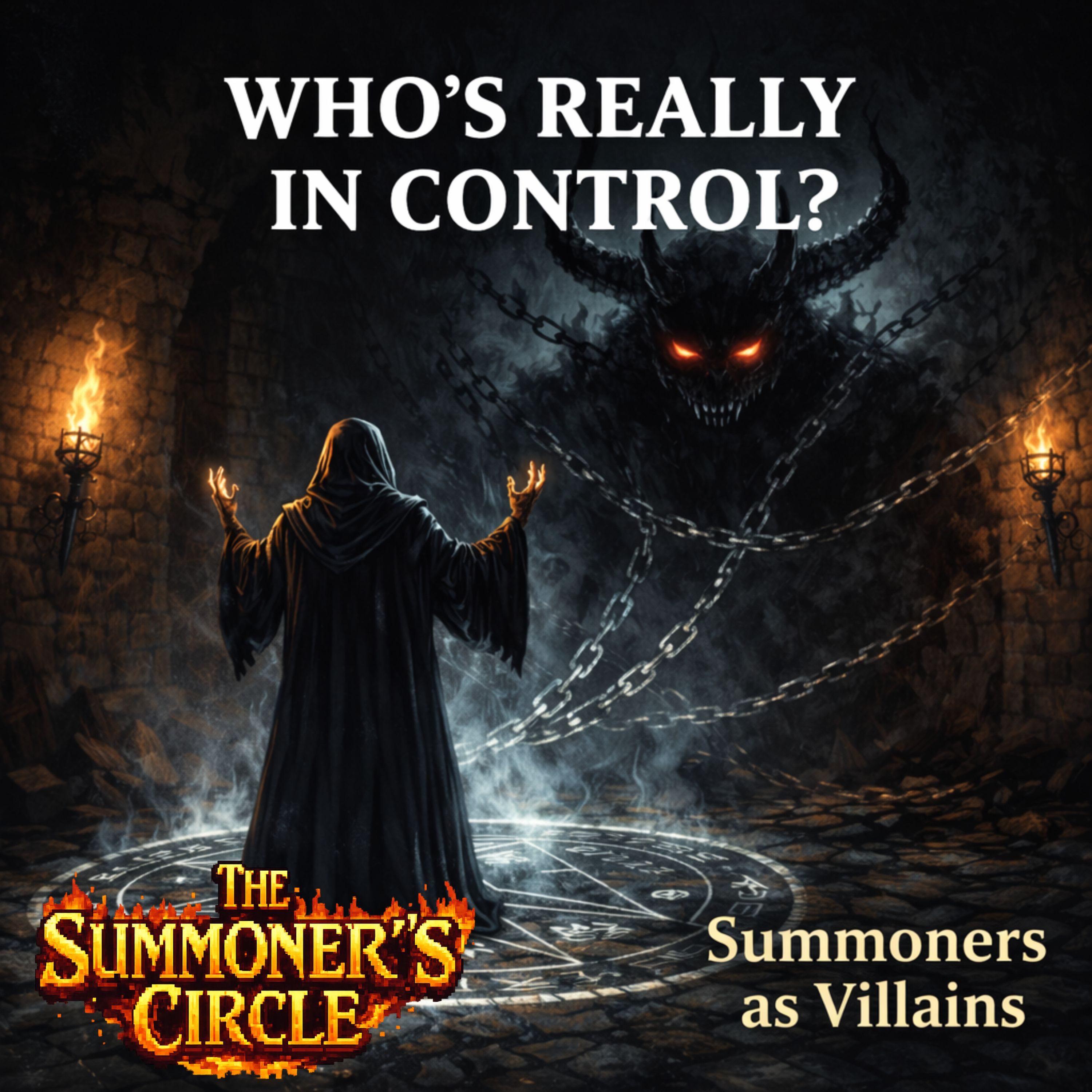
Episode 6 - The Boss Fight Your Players Will Never Forget: Summoners as Villains
The Story
Your players think the Summoner is the boss. The Summoner thinks the demon is. They're both wrong. Learn how to create Summoner villain encounters that players remember for years.... not because they're deadly, but because they're different.
Got a wild story or a cursed character build? Send it our way at Railgunsanddragons.com or email [email protected]. Your madness could shape a future episode.
#ttrpg #palladiumfantasy #roleplaying
Hey folks, welcome back to the table. This is the Summoner Circle Podcast. I'm your host Vince. Today is starting Season 2, Episode 6. Today we're talking a little about something, a little bit that sits right in the intersection of mechanics, tone, and memory. The kind of encounter your players will still be talking about years later, even if they forget the dungeon, map, treasure hall, or the exact stat blocks of whatever. We're talking about running summoners as villains. And we've all probably tried this or done this, or maybe you even thought about the idea.
Not as we're going to run them as a weird MPC, not as a background cultist. Not as a guy in a robe, you stab and and he's pretty much dead. I mean full on prepared, patient, dangerous Summoner. The kind that turned a normal boss fight into something uncomfortable, something tense, something that feels like the world is pushing back. And this fits the show for a couple reasons. Touch upon those as we go. Early episodes talked about the obelisk and summoners as player characters, how they work, why they're strange, why they reward patience and planning.
Today we flip the chair around to look at them from the other side of the screen. Because everything that makes summoners tricky for players is exactly what makes them terrifying as villain. Let me start with the core ID here because this, if you missed this, nothing else matters. The Summoner villain does not fight fair whatsoever. And that's not because they cheat, not because they are overpowered. It's because they don't believe in fair fights. They believe in preparation. That's the difference.
If you design A Summoner villain the same way you design A warlord or dragon or a necromancer, you're going to to end up with something like that's going to fall flat. You have an interesting step lock that dies looking at everything else, and it's not going to be memorable at all. But if you lean into what Palladium actually gives you, summoners become a different category of threat entirely. Here's the hook I want you to keep in your head the whole time when you're building this kind of encounter of a Summoner as your mean villain.
Your players think the Summoner is the boss the Summoner thinks the demon is. They're both wrong. The one idea can carry the entire venture, sometimes an entire campaign arc, depending on how you Let's talk about why this works so well in Palladium fantasy. First, summoners don't rely on initiative, they rely on setup. In Palladium, summoning magic is slow, deliberate interest. It requires circle components, time, and a hell of a lot of willpower. That means anyone who uses it seriously is already thinking ahead of time.
Pairing a Summoner villain doesn't wait in a room hoping the party shows up. They choose where they shape the space around them. They prepare for intrusion. That alone puts the miles ahead of most of the enemies you probably end up or planned up. Second, summoners outsource of violence. This is huge and it's something a lot of GMs under use. A Summoner doesn't not need to be physically dangerous. They don't need high attacks, they don't need impressive armor. They bring something else into the room that doesn't fight for them.
Demons, elementals, entities don't care about your parties plans or your sense of balance. And here's the important part. Those entities? They're not loyal. They are bound. That's a massive difference. Every demon in the Summers encounter should feel like a loaded weapon that might go off in the wrong direction at any really particular moment. That tension should always be present, even if the Summoner currently has control. Now let's talk about something that separates memorable summary villains from the forgettable telegraphing.
If the first time your players realize they're dealing with the Summoner is when the demon appears in the middle of combat, you skip the best part. Summoners announce themselves through evidence, not speech. The world should show signs of their presence long before confrontation. Hat protection, circles carved into stone floors, Chalk symbols smeared on old doors. Unnatural, geometric. Scratched the altar, Animals refusing to enter certain ruins. Livestock found drained malls. People disappearing near old sites with bad reputation.
Rumors matter here. Villagers talk about strange lights at night. Travelers report hearing voices with where no one's. Hunters refuse to go to certain places because of freebies. None of this requires exposition. None of this requires lore dump. It just creates an unease. And here's what happens when players put those pieces together. They slow down, they stop charging into rooms, they stop assuming they're in control. They start asking smart questions, just questions in general. That's engagement.
That's what. Now let's talk about the Summoner's layer, because this is where a lot of the encounters either shine or really fall apart. The Summoner should never be fought in space. Well, no Tavern brawls, no roadside ambushes, no random clearings. The layer of the Summoner is the extension of their magic. That's where the magic happens. Old ruins are perfect. Collapsed temples, flats the floor, abandoned fortifications, anywhere circles can be drawn, detected by this. Here's a practical GM tip that matters more than you think.
Do not hide all the circles. Let the players actually see them. The moment a party walks into a chamber and sees a protected circle already in place, that kind of changes the tone of everything. Now they're not just thinking about attacks. They think their option and the circle be broken. Can it be disrupted? Can it be bypassed? That turns into a small fight into a problem. Now let's talk about the summoners themselves here, because we're talking about them in circling around a circle, because betrayal really matters when it comes to the summoners.
A Summoner villain should not open with violence, how they're action. They open with confidence. They know they're protected. Something worse is coming. They know the party is already. This is a great moment for dialogue, but not really a long speech. Sure, you can be a Bond villain, tell us everything that you're going to do, but not too long. Maybe just a little gloating. Fine, you know, short statement, calm observations, something like you know you shouldn't be here, you don't understand what you're interrupting.
Leave now. If the party pushes, the Summoner will escalate. Not by attacking, by finishing some. A chant completes. A candle flares, blood hits the stone. Who knows? That's when the initiative really starts to matter. And this is where you avoid a common mistake. Do not make the demon, the boss, and the Summoner an afterthought. The Summoner remains relevant the entire time. They're issuing the commands. They're maintaining control, They're reacting disruption. This is where Palladium's control mechanics shine.
Mental endurance roles, battle of wills and resisting domination. The fight is not just physical, it's psychological. Players notice when the demon hesitates. They realize control isn't exactly just perfect. They smell weaknesses. That creates opportunities for well, it's talking about next, breaking the setup, because this is where players feel clever, and Palladium rewards clever play. Circles can be disruptive, sure. Not easy, and it's probably not always done safely, but they can be disrupted.
Shock can be smeared. Carvings can be damaged, power sources interrupted. Every one of these actions should carry a certain amount of risk. Breaking a circle might release something. Who knows? Interrupting A ritual might cause backlash. Damaging a power circle might be stabilized the entire chamber. This is not a puzzle with one right answer. It's a dangerous situation full of bad choices. And that's Palladium in a nutshell. Now, talking about things, let's talk about the failure of the situation, because this is where a lot of GM's get nervous.
If the party loses to a Summoner villain, the campaign should not exactly end. It should change the tone of it. Summoners don't usually kill useful captive. They bind them, they drain them, they experiment with characters might wake up inside imperfect circles, weakened, marked, stripped of gear. Now the goal is in victory. It's kind of how am I going to escape this situation? Escape sessions are one of the strongest and memorable things you pretty much any fantasy players are cautious, they're creative, they're tense, but in a good way.
It's a fun way. They learn more about the villain they never would have thought would have ever thought in a straight fight. They see the summoners habits, they see the demon's resentment, see the cracks in the setup, and that sets up return confrontation that feels earned. That is where I want to pause for a moment because we've covered the philosophy, the tone, the structure. What we'll do. We'll talk about get a little more concrete with our specific encounter instructors using demon stable allies instead of OB pets, What happens when control break and fight and how to end a summoning arc or be with a clean.
That's where the real payout. So let's get a little more concrete now, because philosophy is only useful if it turns into something you can actually run. I want to talk about encounter structure, because Summoner villains fall apart fast if you treat them like a single room and that frankly, boring. A Summoner encounter should feel layered, but not too complicated, but just layered. There's a difference in terms of approach, disruption, confrontation, and aftermath. Not acts, not phases, just pressure.
Like the approach is where tension starts. The party is moving towards the summoner's location and things feel rewards that don't trigger on them but clearly exists. Circles that are inactive but signs that someone else came here but didn't move. This is where players should start realizing they're not walking to a fair fight. Disruption phase happens before initiative. That is where smart parties try to interfere. They break symbols, they steal components, they interrupt preparation. Let them. Never let them do it for free though.
Every disruption is a consequence. Breaking a chalk circle might alert the Summoner. Smearing a ruin might weaken the demons binding but destabilize the area. Stealing the component might force the Summoner to rush the ritual instead of kind of delaying it. This is where everything really shines for Palladium, because the rules don't require you to invent outcomes. The system already supports the backlash and imperfect. Then comes the confrontation. This is where a lot of GM's made the mistake of thinking the fight in the explosive in a way, and it doesn't.
A Summoner concentration works best with starts. Control. Summoner behind a protection circle, the demon restrained but present the party aware that violence will make things worse before and better. This is where players talk more than they swing. Sword threats get made, bargains get floated, Bluffs happen. And the Summoner should not be bluffing. They should be believing they're winning because right now they are. Now the demons themselves. Let's talk a little bit about them because that's the most important piece to get right in this situation.
Demons are not extensions of the Summoner. They are separate characters in the scene. They have their own motives. They resent being bound. They despise weakness. They are constantly looking for any type of leverage, even when controlled. The demon should feel like it's watching everyone in the room, not just the party. This is where you really lean into some description. The demon reacts when the Summoner is in, it acts, it reacts when the circle flickers, it reacts when somebody says to someones name.
These aren't mechanics, they're just little. Players should realize slowly that the demon is not exactly loyal, and when control starts to slip, that realization becomes panic. Now let's talk about control breaking, because that is where the Summoner encounters become legend. When control breaks, do not default to demon just attacking the party. I am demon, I will attack. That's predictable. Instead, ask yourself a simple question. Who does the demon hate the most in this room? Sometimes, well, probably some more than sometimes.
It's most of the time it's the Summoner. Sometimes it's the weakest party member. Sometimes it's just anyone doesn't legit. Sometimes the demon doesn't attack at all. Sometimes it laughs. It's an offer. This is where Palladium allows you to do something most systems struggle with. Let the fight turn sideways. A demon might turn on the Summoner and drag them into the circle. A demon might bargain with the party for freedom. A demon might try to escape entirely, turning the encounter into damage control instead of victory.
Imagine that. A demon running wild. He was summoned as a car. Carry a chaos. None of these outcomes are really failure. They're all story accelerants. Talking about other things here like pacing because the Summoner encounters drag if you're not really careful. The key is urgency without artificial. Don't say you have 3 rounds, say the chant is almost complete. Don't say the demon gets stronger every turn, Show it straining against the circle, show cracks forming, show blood pooling where it shouldn't.
Players don't need numbers to feel pressure, they need consequences. Now let's talk about player role because every character should matter in this kind of encounter. The fighter isn't just here to hit things. They break circles, they shove enemies into dangerous spaces. They physically disrupt the environment. The thief like character isn't just backstabbing, they're cutting ritual cords. They're stealing components. They sabotage symbols. The mages aren't just casting damage, they're they're countering energies.
They identify weak points and recognize what happened was wrong. The group isn't just fighting a monster, they're dismantling a situation. And that's why encounters stick. So OK, we've talked about all these things. What about losing? Because this is where a Summoner villain really separates themselves from standard bosses. If the party loses, it's not the pivoting summoners again. Don't kill usual captives. They bind them, they drain them, they study them. Characters waked up, restrained inside flawed circles, weakened, disoriented, and marked.
Now the game. Everything else we've talked about escape. Turning the summoner's tools against them. These sessions are incredible players stop thinking in terms of building and start thinking in terms of survival. They notice details, they exploit habits, they learn the Summoners Week, and they finally escape the rematch. So how do we end the Summoner arc? Because this matters more than itself. The Summoner are always dyke. Sometimes they escape and become a reoccurring villain threat to the campaign, which is a lot of fun and memorable.
Sometimes they are consumed by the thing they thought they trolled. Sometimes they leave them behind. Consequences Closure. The worst ending for a Summoner villain is simply a corpse and a loop. Instead, think about the aftermath of the What happens to the site? What happens to the demonies? What rumors spread afterward? Maybe the land remains tainted? Be something else Noticed the disturbance. Be the party inherits a dangerous location they now have to deal with. That's how one villain becomes camp direct.
Now let me give you a concrete example, because this always does. I once ran a Summoner who never attacked the party directly. Every encounter was shaped by preparation. Every fight involves something. When they finally cornered him, control slipped. The demon didn't attack the party, it grabbed him and dragged him screaming into the circle. Party didn't shear, they just stood there, quietly fused. That silence told me everything. Now let me zoom out here for a minute and bring you back to the core of the advanced.
Why does this work so well here? Because the system supports preparation, stability, and concepts. You're not forcing the game differently, you're using it as written control. Mechanics matter. Environment matters. Time, Matt Summoner villains aren't about overpowering players, they're about out thinking. And when a player wins, it feels earned and they lose, it feels fair. That's rare. So here's my challenge to you as GM is up there. Next time you design a major villain, don't start with stats.
Start with questions. Where do they feel safe? What have they prepared? What happens if the troll breaks? If those answers shape the battlefield right? That's why summoners do make a powerful villain. They turn a fight into a memory, and that's what we're all for. All right, I think I'm going to wrap it up here next episode we'll shift gears and get practical in different ways. Adventures you can drop into a plain fantasy campaign with almost no prep. I don't know I'm thinking about that if I have enough time in the next week or so to jot down these ideas.
Otherwise I'll just think of something Until then, you keep your circle sealed. Don't trust anything that offers you a deal and remember the real danger usually started long you arrived. Don't forget to subscribe to the channel. It's your first time here. Don't forget to like on Spotify or anything or Apple podcast. Give us a rating. Also head over to patreon.com the evil DM and you can get a newsletter that I weekly for started last week. As of the recording it's called Borderland Threats. What gives you a Palladium idea you can drop right into your campaign?
I'll see you next time. Keep original, keep it all school. Goodnight and God bless everybody.
 Apple Podcasts
 Castbox
 Castro
 Goodpods
 Moon FM
 Overcast
 Pocket Casts
 Podbean
 Podcast Addict
 Podcast Republic
 Spotify